
Capability Maturity Model Integrated CMMI
History of CMMI Certification
The Software Engineering Institute at Carnegie Mellon University, USA, invented the CMMI model as a procedure to improve processes and ease risks related to software, product, and service development. The U.S. Department of War created this model to monitor the quality and capability of their software providers, but this model has inflated worldwide. Currently, the CMMI model is directed by the CMMI Institute, which was acquired by the ISACA in 2016.
What is Standard CMMI Appraisal Method for Process Improvement (SCAMPI)
The Standard CMMI Appraisal method for process improvement (SCAMPI) provides a framework related to the Capability maturity model. It applies to both internal and external capability determinators.
The SCAMPI family of appraisals possesses classes A, B, and C appraisal methods.
SCAMPI A
It is the only method that can result in a rating. It is one of the most rigorous methods. It confirms that the industry is following all the standards and objectives.
SCAMPI B
It is less formal than SCAMPI A as it helps to discover the objectives for the CMMI development level. It assists the industry with a superior notion to remain in the development procedure.
SCAMPI C
This is an evaluation technique. It is much shorter more adaptable and affordable.
CMMI Capability Maturity Model Integration Certification Maturity Levels Explained : Why are they so Important ?
It proposes training programs for professionals and guides them to improve the organization’s development processes. It helps organizations to enhance, build and measure their performance on different parameters.
It is a conduct and procedure model that identifies and resolves process issues, minimizes risk, and promotes building a corporate culture. It addresses three areas Product and service expansion, Service building, and product and service accession.
The Capability Maturity Model Integration Certification CMMI model incorporates multiple CMMIs and intents to deliver a single improvement framework to the industry to enhance processes and services. CMMI version 1.1 was terminated in 2002, and currently, version 2.0 is being operated by the organizations. Each version of CMMI seeks to be more coordinated and comprehensive.
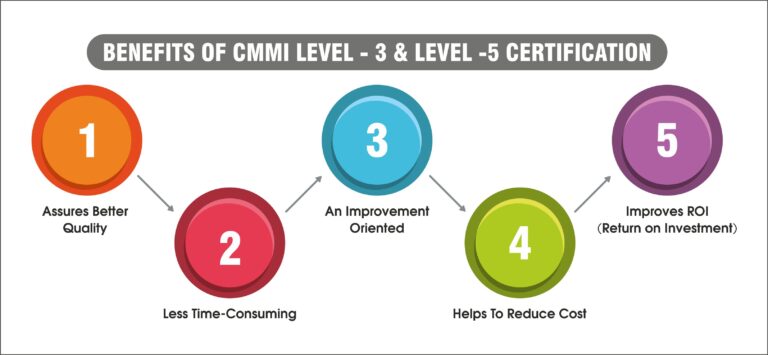
CMMI Level 3 and Level 5 Benefits for Business
- Project & document-management
- Bug-tracker
- Estimation
- Requirement & design-management
- Decision & analysis tools
- Metrics-tools
- Integration-application
Capability Maturity Model Integration Certification CMMI Tools
The Capability Maturity Model Integration Certification CMMI Institute approves outsider associations to sell CMMI apparatuses and administrations, the rundown of endorsed merchants is broad, and you can look by item, area, and language on the CMMI Institute website.
The kind of CMMI apparatuses that will work best for your association will depend upon your business needs. Following the CMMI, you’ll distinguish the best instruments during Capability Maturity Model Integration Certification CMMI Level 2 or 3; now, your Capability Maturity Model Integration Certification CMMI expert will offer suggestions or assist you with structuring tweaked devices based on broad inquiries. The most widely recognized class of apparatuses that you’ll have to consider incorporates:
What are the 5 Levels of CMMI Certification?
Capability Maturity Model Integration CMMI Capability levels are a set of practices that draw a path for an organization to improve its ability and capability related to process areas. These CMMI certification training levels are cumulative, which means higher capability levels include the attributes of the lower levels. These are labeled from level 0 to level 5.
Level 0: Incomplete
It refers to an incomplete process, which shows a delay in setting one or more goals of the process area. It affects the organization’s ability and shows inconsistent performance.
Level 1: Initial
It concentrates on performance issues and prompts the formulation of appropriate practices to meet the intent process area.
Level 2: Managed
It is a complete set of practices and monitors the organization’s performance. It concentrates on project performance objectives and does not use the organization’s assets.
Level 3: Defined
It uses the organization’s assets and focuses on attaining project performance and organizational performance objectives.
Level 4: Quantitatively Managed
Quantitative objectives are established for process and quantity, and criteria are defined for managing the process.
Level 5: Optimising
It continuously focuses on improving project and organizational performance objectives.
What is CMMI Level 3 Certification?
It is achieved when a business successfully meets SCAMPI A proposal, which acts as a hallmark for an organization. It must be performed by a confirmed lead appraiser, who should be in the location evaluation group.
SCAMPI A appraisal verifies that the business is operating at CMMI level 3 certification. It confirms that the industry is following all the standards and objectives.
It is an indicator of the industry’s efficiency and implies that an organization is working on all the standards set to meet Capability Maturity Model Integration ( CMMI) certification process areas and CMMI certification requirements.
What is CMMI Level 5 Certification Process ?
Level 5: Optimising- Stable and flexible
It focuses on persistent process enhancement to implement new techniques and methods that can be enforced to make the organization more efficient.
CMMI level 5 appraisal indicates that the business is at a phase of incomparable stability. It provides the organization with more flexibility to implement new objectives related to the industry’s needs. It ensures that the business is operating and executing required practices to meet process areas.
It also provides a stage for innovation and agility in the organization.
